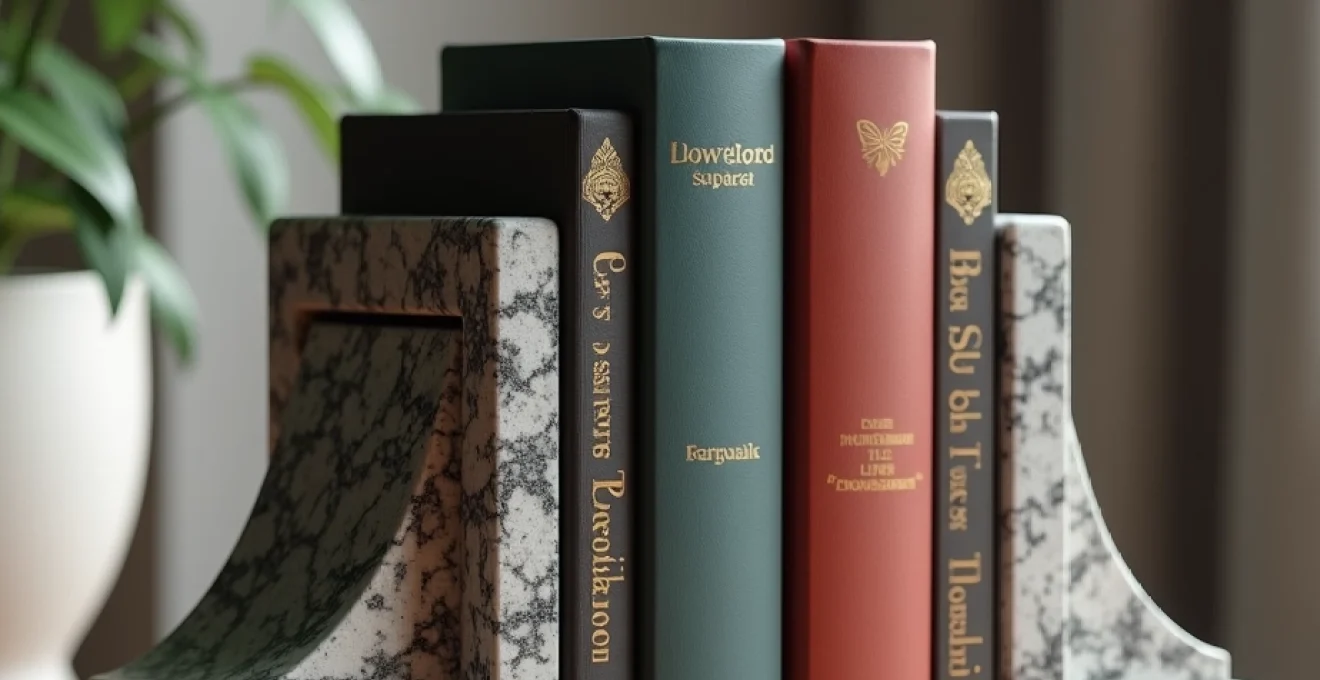
The humble bookend has evolved far beyond its basic functional purpose, transforming into a sophisticated design element that marries aesthetic appeal with practical necessity. These architectural anchors serve as silent guardians of literary collections whilst simultaneously functioning as sculptural statements that define interior spaces. Modern decorative bookends represent the perfect convergence of engineering precision and artistic expression, offering homeowners an opportunity to showcase personal style whilst maintaining organisational integrity. The contemporary market presents an unprecedented array of materials, designs, and technological innovations that cater to diverse aesthetic preferences and functional requirements.
Today’s discerning consumers recognise that bookends are more than mere book supports—they are micro-architectural elements that contribute significantly to spatial harmony and visual storytelling. From weight-engineered bases to culturally-inspired motifs, these accessories demonstrate how thoughtful design can elevate everyday objects into conversation pieces that enhance both form and function within living spaces.
Material engineering and structural design principles in premium bookend construction
The foundation of exceptional bookend performance lies in sophisticated material selection and engineering principles that govern structural stability. Modern manufacturers employ rigorous testing protocols to ensure their products can withstand varying load conditions whilst maintaining aesthetic integrity over extended periods. The relationship between material density, surface friction, and gravitational resistance determines how effectively a bookend performs its primary function.
Contemporary design approaches integrate advanced manufacturing techniques with traditional craftsmanship, resulting in products that exhibit superior durability characteristics. Material scientists have identified optimal thickness-to-weight ratios that maximise stability whilst minimising unnecessary bulk, creating bookends that appear elegant yet possess formidable structural capabilities.
Cast iron vs wrought iron: tensile strength analysis for heavy volume support
Cast iron bookends offer exceptional compressive strength, typically ranging from 140-200 MPa, making them ideal for supporting extensive hardcover collections. The material’s inherent brittleness, whilst limiting flexibility, provides unwavering stability that prevents gradual shifting under continuous load pressure. Manufacturing processes allow for intricate decorative details that retain structural integrity through precise moulding techniques.
Wrought iron alternatives exhibit superior tensile strength characteristics, measuring approximately 300-400 MPa, whilst offering enhanced resistance to impact damage. This material’s malleable properties enable artisans to create flowing, organic designs that complement traditional and contemporary interior schemes. The corrosion resistance of properly treated wrought iron ensures longevity in various environmental conditions, making these bookends particularly suitable for libraries and studies with varying humidity levels.
Marble and granite density coefficients: natural stone selection for optimal stability
Natural stone bookends leverage density coefficients ranging from 2.6-3.0 g/cm³ to achieve exceptional stability through pure mass distribution. Carrara marble, with its density of approximately 2.7 g/cm³, provides elegant aesthetic appeal whilst maintaining sufficient weight to secure substantial book collections. The material’s inherent veining patterns ensure each bookend possesses unique visual characteristics that enhance rather than dominate surrounding décor.
Granite alternatives offer superior density ratings of 2.8-3.0 g/cm³, delivering enhanced stability for particularly heavy or extensive collections. The material’s resistance to scratching and staining makes granite bookends practical choices for high-traffic areas where durability concerns outweigh pure aesthetic considerations. Polished granite surfaces create striking visual contrasts when paired with leather-bound volumes or contemporary publication designs.
Powder-coated steel base architecture: Anti-Slip surface engineering
Advanced powder-coating technologies create micro-textured surfaces that significantly enhance friction coefficients between bookends and shelf surfaces. These engineered coatings typically increase surface resistance by 40-60% compared to untreated metal alternatives, preventing gradual sliding that commonly afflicts inadequately designed products. The coating process also provides corrosion protection that extends product lifespan considerably.
Multi-layer coating systems incorporate base primers, colour coats, and protective topcoats that maintain surface integrity under varying temperature and humidity conditions. The resulting finish exhibits superior chip resistance whilst maintaining smooth surfaces that won’t damage adjacent furniture or book covers. Modern formulations include anti-microbial properties that contribute to healthier indoor environments, particularly relevant for children’s libraries and educational settings.
Weighted distribution mechanics: centre of gravity calculations in L-Shaped designs
L-shaped bookend configurations rely on precise centre-of-gravity calculations to achieve optimal stability whilst minimising footprint requirements. Engineers position weighted elements to create low centre-of-gravity points that resist tipping forces generated by uneven book arrangements or accidental impacts. Mathematical modelling ensures weight distribution occurs at approximately one-third of the base length from the vertical support element.
Advanced designs incorporate adjustable weighting systems that allow users to modify stability characteristics based on specific collection requirements. These systems typically employ removable weight inserts that can increase total mass by 20-40% when supporting particularly heavy or tall volumes. The modular approach enables customisation without compromising aesthetic consistency or requiring multiple bookend purchases.
Aesthetic design movements and cultural influences in contemporary bookend artistry
Contemporary bookend design draws inspiration from diverse artistic movements and cultural traditions that reflect evolving interior design preferences and cultural sensibilities. These influences manifest through material choices, geometric forms, colour palettes, and symbolic representations that resonate with specific demographic preferences and lifestyle aspirations. Design studios increasingly incorporate ethnographic research to ensure their products authentically represent cultural aesthetics whilst avoiding appropriation concerns.
The globalisation of design markets has created opportunities for cross-cultural pollination that produces innovative hybrid aesthetics combining traditional techniques with contemporary materials. This evolution reflects broader trends in home décor where consumers seek objects that tell stories and express personal identity through carefully curated collections of meaningful artefacts.
Art deco revival: geometric patterns in modern library accessories
The resurgence of Art Deco aesthetics in contemporary bookend design reflects renewed appreciation for bold geometric forms and luxurious material combinations. Modern interpretations employ brass accents, stepped profiles, and sunburst motifs that capture the movement’s optimistic energy whilst adapting to current manufacturing capabilities. These designs particularly appeal to collectors of vintage literature and enthusiasts of mid-century modern interior schemes.
Contemporary manufacturers utilise precision machining techniques to achieve the sharp angles and perfect symmetry that define authentic Art Deco aesthetics. Brushed bronze finishes and contrasting material combinations create visual drama that transforms functional bookends into striking sculptural elements. The movement’s emphasis on craftsmanship quality aligns perfectly with modern consumers’ preferences for durable, well-engineered home accessories.
Scandinavian minimalism: functional beauty through reduced form language
Nordic design philosophy emphasises simplicity, functionality, and natural material appreciation that translates beautifully into bookend aesthetics. Clean lines, blonde wood tones, and understated profiles create products that integrate seamlessly with minimalist interior schemes whilst providing exceptional functional performance. The philosophy’s emphasis on sustainability influences material selection towards renewable and ethically sourced options.
Scandinavian-inspired bookends typically feature organic curves and tactile surfaces that invite interaction whilst maintaining visual restraint. The design approach prioritises longevity through timeless aesthetics that transcend temporary trends, making these products excellent long-term investments for design-conscious consumers. Natural material variations celebrate rather than hide manufacturing imperfections, creating unique character in each piece.
Industrial heritage: steampunk elements in Victorian-Inspired bracket systems
The steampunk aesthetic celebrates industrial heritage through brass fittings, exposed mechanical elements, and weathered metal finishes that evoke Victorian-era engineering achievements. Modern bookend interpretations incorporate functional elements like adjustable brackets, spring-loaded mechanisms, and authentic industrial hardware that enhance both visual appeal and practical utility. These designs particularly attract collectors of classic literature and vintage industrial décor enthusiasts.
Authentic steampunk bookends often feature working components such as pressure gauges, gear mechanisms, or lever systems that provide interactive elements beyond basic book support. The aesthetic celebrates the beauty of functional engineering whilst creating conversation pieces that spark curiosity and admiration. Distressed copper and brass finishes develop natural patina over time, enhancing rather than diminishing their visual appeal.
Biophilic design integration: Nature-Inspired motifs in urban interior spaces
Biophilic design principles recognise humanity’s innate connection to nature and translate these relationships into built environments through organic forms, natural materials, and nature-inspired patterns. Bookend designs incorporating leaf motifs, tree branch structures, or flowing water patterns provide psychological benefits by introducing natural elements into urban living spaces. Research indicates that biophilic design elements can reduce stress levels and improve cognitive function.
Modern manufacturing techniques enable realistic reproduction of natural textures and forms that previously required extensive handcrafting. Digital scanning of actual botanical specimens allows designers to capture intricate details in cast metal or moulded resin products that maintain affordability whilst preserving authenticity. These bookends often incorporate living elements such as small planters or moss gardens that blur boundaries between functional objects and living décor.
Load-bearing capacity testing and book collection weight distribution
Professional load-bearing capacity testing employs standardised protocols that simulate real-world usage conditions over extended periods to verify manufacturer claims and ensure consumer safety. Testing laboratories subject bookends to graduated weight increases whilst monitoring stability markers including lateral movement, base lifting, and structural deformation. These comprehensive evaluations typically examine performance under loads ranging from 5-50 kilograms to accommodate diverse collection types and sizes.
Weight distribution analysis reveals that average hardcover books exert 0.8-1.2 kilograms of lateral pressure per linear inch when properly arranged, whilst oversized art books or technical manuals can generate forces exceeding 2.0 kilograms per inch. Understanding these dynamics enables consumers to select appropriate bookends for their specific collections whilst preventing potential damage to books or furniture surfaces.
Dynamic loading tests simulate the repetitive stress patterns generated by regular book removal and replacement activities that occur in active library environments. These evaluations measure fatigue resistance and identify potential failure points that might not manifest during static load testing. Results indicate that quality bookends should maintain structural integrity through minimum 10,000 loading cycles without measurable performance degradation.
Advanced testing protocols now incorporate vibration analysis to evaluate bookend performance in environments subject to structural movement, traffic vibrations, or seismic activity that could affect stability over time.
Temperature cycling tests examine how thermal expansion and contraction affect material stability and joint integrity across seasonal variations. Metal bookends particularly benefit from these evaluations as thermal coefficients can influence dimensional stability and surface finish quality. Results inform material selection decisions and help manufacturers develop products suitable for various climatic conditions and installation environments.
Surface protection technologies and furniture preservation methods
Contemporary bookend designs incorporate sophisticated surface protection technologies that prevent damage to valuable furniture surfaces whilst maintaining aesthetic integrity and functional performance. Advanced polymer base materials distribute weight evenly across contact areas whilst providing cushioning that absorbs minor impacts and prevents scratching of delicate wood finishes or glass shelving surfaces.
Micro-cellular foam technologies create protective interfaces that conform to surface irregularities whilst maintaining consistent contact pressure distribution. These materials exhibit excellent durability characteristics and resist permanent compression deformation that could compromise protective effectiveness over time. Chemical composition ensures compatibility with various furniture finishes including lacquers, polyurethanes, and natural wood oils without causing staining or finish degradation.
Anti-vibration technologies prevent the transmission of mechanical energy that could cause gradual surface wear or furniture movement over extended periods. Specialised dampening materials absorb vibrational energy whilst maintaining sufficient friction to prevent bookend migration during normal usage patterns. These innovations particularly benefit installations on antique furniture or surfaces where preservation concerns outweigh other considerations.
Professional furniture conservators recommend bookends with adjustable protection systems that can accommodate varying surface sensitivities and finish types without requiring permanent modifications or additional protective measures.
Smart protection systems incorporate moisture barriers that prevent humidity transfer between bookends and furniture surfaces, addressing concerns about wood movement and finish degradation in environments with variable atmospheric conditions. These barriers maintain breathability to prevent moisture accumulation whilst providing effective protection against direct contact damage.
Space optimisation algorithms for compact living and office environments
Modern space optimisation strategies employ mathematical algorithms that calculate optimal bookend positioning to maximise storage efficiency whilst maintaining visual harmony within constrained environments. These calculations consider factors including book dimension variations, shelf depth limitations, and sight line aesthetics to determine placement patterns that achieve maximum utility per square inch of available space.
Computational analysis reveals that strategic bookend positioning can increase effective storage capacity by 15-25% compared to random placement patterns. The algorithms account for visual weight distribution, colour coordination, and scale relationships that influence perceived spaciousness within compact environments. Professional space planners increasingly utilise these tools to optimise client installations for both functionality and aesthetic appeal.
Vertical storage efficiency: maximising shelf real estate through strategic placement
Vertical storage optimisation examines how bookend positioning influences overall shelf utilisation efficiency and visual organisation. Research indicates that placing bookends at precise intervals creates psychological organisation zones that encourage more systematic book arrangement and easier retrieval. The optimal spacing typically ranges from 60-90 centimetres depending on average book height and collection density requirements.
Multi-tier bookend systems enable vertical subdivision of tall shelving units into manageable sections that prevent book leaning and facilitate easier access to specific titles. These systems often incorporate adjustable height mechanisms that accommodate varying book sizes whilst maintaining consistent visual rhythm throughout the installation. The approach particularly benefits extensive collections where traditional single-level organisation becomes unwieldy.
Modular stacking systems: expandable bookend configurations for growing collections
Modular bookend systems address the dynamic nature of book collections through expandable configurations that adapt to changing storage requirements without requiring complete system replacement. These designs typically employ standardised connection interfaces that enable seamless integration of additional components as collections grow or spatial arrangements change.
Interlocking mechanisms ensure structural stability whilst providing flexibility for future reconfiguration based on evolving needs or spatial constraints. Quality modular systems maintain consistent aesthetic appearance regardless of configuration complexity, enabling users to create custom arrangements that reflect personal preferences and functional requirements. Investment value increases as modular systems provide long-term adaptability compared to fixed alternatives.
Corner utilisation techniques: angular bookend positioning in awkward spaces
Corner utilisation strategies address challenging spatial configurations where traditional bookend placement proves ineffective or visually disruptive. Specialised angular bookends accommodate acute and obtuse corner angles whilst maintaining stability characteristics equivalent to conventional designs. These solutions often incorporate adjustable angular positioning that accommodates various corner configurations without compromising performance.
Three-dimensional corner systems create stable triangular configurations that maximise storage capacity in previously unusable spaces. The geometric approach distributes loads across multiple support points whilst creating visually interesting installations that transform problematic corners into functional storage areas. Professional installation techniques ensure structural adequacy whilst maintaining easy access for book management activities.
Investment value analysis: collectible designer bookends vs Mass-Market alternatives
The collectible bookend market demonstrates significant appreciation potential with designer pieces from established artisans commanding premium prices and showing consistent value growth over time. Limited edition productions from recognised studios often appreciate 8-15% annually, whilst mass-market alternatives typically depreciate or maintain stable values based primarily on functional utility rather than artistic merit.
Investment analysis reveals that bookends combining exceptional craftsmanship, historical significance, or association with renowned designers offer superior long-term value retention compared to purely functional alternatives. Market data indicates that pieces featuring precious metals, rare materials, or documented provenance command the highest premiums and demonstrate greatest appreciation potential over extended holding periods.
Authentication considerations become increasingly important as the collectible market matures and reproduction quality improves. Professional appraisal services now specialise in bookend authentication using techniques including material analysis, construction method examination, and stylistic comparison with documented examples. Insurance valuations require periodic updates as market values fluctuate based on collector interest and available supply.
Serious collectors recommend focusing on pieces that demonstrate exceptional craftsmanship quality and unique artistic merit rather than following temporary market trends that may not sustain long-term value appreciation.
Portfolio diversification strategies suggest combining high-value designer pieces with practical everyday bookends to balance aesthetic enjoyment with functional utility. This approach enables collectors to appreciate their investments through daily use whilst maintaining preservation standards appropriate for valuable objects. Documentation including purchase records, condition reports, and photographic evidence supports future valuation activities and insurance coverage requirements.