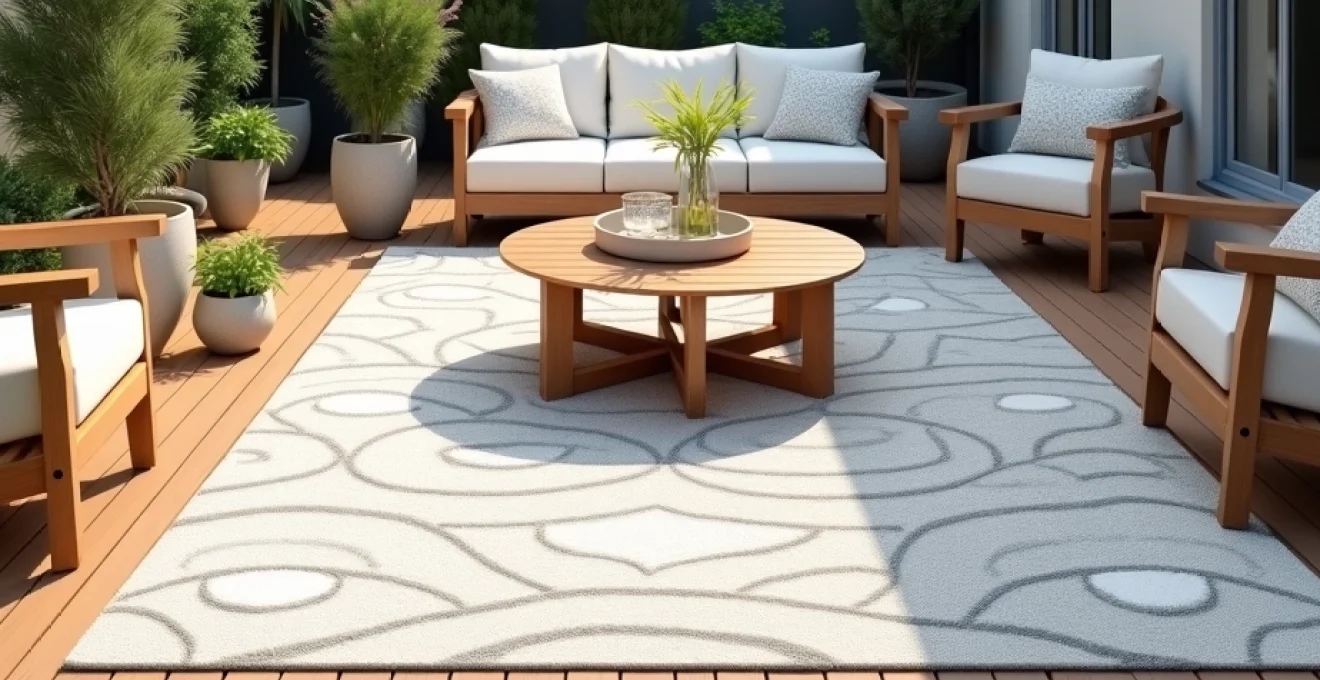
Outdoor rugs have evolved from simple utility items to sophisticated design elements that can transform any patio into a cohesive, inviting living space. Modern outdoor textiles offer unprecedented durability whilst maintaining the aesthetic appeal that rivals their indoor counterparts. The strategic placement of well-chosen outdoor rugs creates defined zones, introduces colour and texture, and establishes visual continuity between interior and exterior spaces. Whether you’re working with a compact balcony or an expansive terrace, understanding the principles of outdoor rug selection and placement ensures your patio design achieves both functional excellence and visual harmony.
Material selection and weatherproofing considerations for outdoor rugs
The foundation of successful outdoor rug design lies in selecting materials engineered to withstand Britain’s unpredictable weather patterns. Performance fabrics have revolutionised outdoor textiles, offering solutions that maintain their integrity through seasonal transitions whilst preserving aesthetic appeal. Understanding material properties enables informed decisions that balance durability requirements with design aspirations.
Polypropylene vs natural fibre performance in british climate conditions
Polypropylene stands as the gold standard for outdoor rug applications, particularly in Britain’s moisture-rich environment. This synthetic material exhibits exceptional hydrophobic properties, repelling water rather than absorbing it. The closed-cell structure prevents moisture penetration, eliminating the risk of mildew formation that plagues natural fibres in damp conditions. Polypropylene rugs maintain dimensional stability through temperature fluctuations, whilst their inherent stain resistance simplifies maintenance protocols.
Natural fibres such as jute, sisal, and wool present significant challenges in outdoor applications. These materials readily absorb moisture, creating breeding grounds for mould and mildew. The organic composition makes them susceptible to insect damage and UV degradation. However, treated natural fibres with protective coatings can offer limited outdoor performance, though they require vigilant maintenance and seasonal storage.
Uv-resistant treatment technologies and fade prevention methods
Solar radiation poses the greatest threat to outdoor rug longevity, with UV exposure causing rapid colour degradation in untreated textiles. Solution-dyed fibres represent the pinnacle of fade resistance technology, where pigments are integrated during the polymer formation process rather than applied post-production. This method ensures colour permanence even under intense solar exposure.
Modern UV stabilisers create molecular shields that absorb harmful radiation before it reaches the dye molecules. Hindered amine light stabilisers (HALS) and benzotriazole compounds provide ongoing protection throughout the rug’s lifespan. Quality outdoor rugs incorporate multiple UV protection layers, including topical treatments and inherent fibre modifications.
Drainage properties and mould prevention in High-Moisture environments
Effective drainage design prevents water accumulation that leads to structural damage and biological contamination. Quality outdoor rugs feature permeable backing materials that allow moisture to pass through whilst maintaining structural integrity. Open-weave constructions facilitate air circulation, promoting rapid drying after precipitation events.
Anti-microbial treatments provide additional protection against biological growth. Silver ion technology and zinc pyrithione compounds inhibit bacterial and fungal development without compromising human safety. These treatments remain effective throughout multiple cleaning cycles, providing long-term protection in high-humidity environments.
Texture analysis for Anti-Slip performance on various decking materials
Surface safety requirements vary significantly across different decking substrates, necessitating careful texture consideration. Smooth concrete surfaces require rugs with aggressive backing patterns to prevent displacement, whilst textured decking may accommodate lower-profile designs. Coefficient of friction measurements provide objective safety assessments, with values above 0.6 indicating adequate slip resistance for pedestrian traffic.
Backing materials significantly influence grip characteristics. Rubber compounds offer superior traction on hard surfaces but may mark certain decking materials. PVC backings provide moderate grip whilst maintaining surface compatibility across diverse substrates. Felt backings, whilst gentle on surfaces, offer minimal slip resistance and are unsuitable for high-traffic applications.
Spatial planning and scale proportioning techniques
Effective outdoor rug placement requires understanding spatial relationships between furniture arrangements, traffic patterns, and architectural elements. Proportional harmony creates visual balance that enhances perceived space whilst establishing functional zones. Mathematical principles guide optimal sizing decisions, ensuring rugs complement rather than overwhelm outdoor environments.
Golden ratio application in Rug-to-Furniture spacing calculations
The golden ratio (1:1.618) provides time-tested proportional guidance for outdoor furniture arrangements. When applied to rug sizing, this principle suggests that rug dimensions should extend beyond furniture footprints by approximately 61.8% of the furniture’s width or length. For dining sets, this translates to rugs extending 60-90cm beyond table edges, accommodating chair movement whilst maintaining visual proportion.
Seating arrangements benefit from the two-thirds rule, where rugs should be large enough to accommodate at least the front legs of all furniture pieces. This creates visual anchoring without overwhelming smaller spaces. Larger patios can accommodate full-furniture placement on rugs, creating intimate conversation zones within expansive areas.
Zonal demarcation using rug boundaries for Multi-Functional patios
Strategic rug placement creates distinct activity zones without physical barriers, enabling flexible space utilisation. Dining areas require stable, low-pile rugs that facilitate chair movement whilst maintaining visual definition. Lounging zones benefit from softer textures and larger dimensions that encourage relaxation and social interaction.
Transitional areas between zones can utilise runner-style rugs that guide movement whilst maintaining design continuity. These connecting elements prevent spaces from appearing fragmented whilst providing practical pathway definition. Colour coordination between zonal rugs ensures overall design cohesion despite functional diversity.
Traffic flow pattern analysis and pathway integration
Understanding pedestrian movement patterns enables strategic rug placement that enhances rather than impedes circulation. Primary pathways should remain unobstructed, with rugs positioned to channel traffic around seating and dining areas. Secondary circulation routes can accommodate runner rugs that provide comfort underfoot whilst guiding movement towards specific destinations.
Entry points require particular attention, as these areas experience the highest traffic volumes and soil transfer. Durable, easy-clean materials prove essential in these applications, with darker colours and patterns that camouflage inevitable soiling. Transition areas between interior and exterior spaces benefit from consistent colour palettes that create visual continuity.
Corner radius considerations for L-Shaped and irregular patio geometries
Non-rectangular patio configurations present unique challenges for rug integration, requiring creative solutions that accommodate architectural constraints. L-shaped spaces benefit from multiple smaller rugs rather than single large pieces, allowing flexible arrangement that adapts to seasonal usage patterns. Corner areas often remain underutilised but can become intimate gathering spots with appropriate rug selection.
Custom cutting services enable perfect fitting for irregular spaces, though this approach eliminates future repositioning flexibility. Alternatively, layering multiple standard-size rugs creates dynamic arrangements that can be reconfigured as needs evolve. This approach proves particularly valuable for rental properties where permanent modifications aren’t feasible.
Colour theory and pattern psychology in outdoor environments
Colour selection for outdoor rugs requires understanding how natural lighting conditions affect perception throughout the day and across seasons. Chromatic considerations extend beyond personal preference to encompass psychological impacts, spatial perception effects, and integration with surrounding landscape elements. The interplay between natural and artificial lighting creates dynamic colour relationships that shift dramatically from dawn to dusk.
Cool colours such as blues, greens, and purples create calming atmospheres whilst visually expanding spatial perception. These hues complement natural foliage and sky tones, creating seamless integration with outdoor environments. Warm colours including reds, oranges, and yellows generate energy and intimacy but can overwhelm smaller spaces if applied extensively. The key lies in achieving balance through strategic accent placement and neutral foundation elements.
Pattern psychology influences spatial perception and emotional responses in measurable ways. Large-scale patterns create bold focal points but can make spaces appear smaller, whilst small-scale patterns provide subtle interest without overwhelming compact areas. Geometric patterns suggest order and sophistication, appealing to contemporary design sensibilities. Organic patterns reference natural forms, creating harmonious relationships with garden settings.
The phenomenon of simultaneous contrast affects how colours appear when placed adjacent to others. Neutral grey appears warmer beside cool colours and cooler beside warm hues. This principle enables sophisticated colour orchestration where single rugs can bridge multiple colour families within outdoor furniture arrangements. Understanding these relationships prevents costly selection errors and ensures long-term design satisfaction.
Outdoor colour selection must account for the transformative effects of natural lighting, where colours appear dramatically different under direct sunlight compared to shaded conditions or artificial illumination.
Installation methods and surface preparation protocols
Proper installation techniques ensure outdoor rugs perform optimally throughout their service life whilst preventing common problems such as curling, shifting, and premature wear. Surface preparation forms the foundation of successful installations, requiring assessment of substrate conditions and implementation of appropriate corrective measures. Professional installation approaches differ significantly from indoor applications due to environmental exposure and drainage requirements.
Substrate compatibility assessment for concrete, stone, and composite decking
Different decking materials present unique challenges and opportunities for rug installation. Concrete surfaces offer excellent stability but may require texture modification for optimal grip. Power washing removes surface contaminants that compromise adhesion, whilst light acid etching increases surface texture for improved rug retention. Expansion joints require special consideration to prevent rug damage during thermal cycling.
Natural stone surfaces provide inherent texture that aids rug stability but may present irregular profiles requiring levelling interventions. Sandstone and limestone surfaces may require sealing to prevent water absorption that could affect rug performance. Slate and granite surfaces typically need minimal preparation beyond thorough cleaning and debris removal.
Composite decking materials vary significantly in surface characteristics and thermal expansion properties. PVC-based composites remain dimensionally stable but may become slippery when wet, requiring rugs with aggressive backing materials. Wood-plastic composites expand and contract seasonally, necessitating flexible attachment methods that accommodate movement without damage.
Adhesive-free anchoring systems and Wind-Resistance solutions
Modern anchoring systems provide secure rug retention without permanent surface modifications, preserving flexibility for seasonal arrangements and rental applications. Weighted systems utilise discrete masses positioned around rug perimeters, providing stability without visible hardware. These systems prove particularly effective for temporary installations and areas where drilling isn’t permitted.
Vacuum-based retention systems create suction attachment to smooth surfaces, offering excellent holding power whilst remaining completely removable. These systems work particularly well on sealed concrete and composite decking surfaces. Regular maintenance ensures optimal performance, as debris accumulation reduces suction effectiveness.
Spike systems penetrate between decking boards or into joint material, providing mechanical retention without surface damage. Adjustable spike lengths accommodate various decking thicknesses and joint configurations. These systems prove ideal for areas experiencing high wind loads where other retention methods prove insufficient.
Levelling techniques for uneven surfaces and gradient management
Surface irregularities create wear patterns and safety hazards that compromise rug performance and longevity. Self-levelling compounds provide permanent solutions for minor surface variations, whilst adjustable pedestals offer reversible levelling for rental situations. The approach selection depends on the degree of irregularity and permanence requirements.
Drainage considerations become critical when modifying surface gradients, as improper levelling can create water accumulation areas. Maintaining minimum 2% slopes towards drainage points prevents standing water that damages rugs and creates safety hazards. French drain installation may be necessary in areas with significant water collection issues.
Maintenance protocols and seasonal storage strategies
Systematic maintenance programmes extend outdoor rug lifespan whilst preserving aesthetic appeal throughout demanding service conditions. Preventive maintenance proves far more cost-effective than reactive approaches, requiring regular inspection schedules and prompt attention to emerging issues. Professional-grade maintenance techniques adapted to domestic applications ensure optimal performance without excessive complexity.
Daily maintenance involves removing debris and addressing spills before they become permanent stains. Weekly deep cleaning using appropriate equipment and products removes accumulated soil and prevents biological contamination. Monthly inspections identify developing problems such as backing deterioration, edge curling, or fastener loosening that require immediate attention.
Seasonal maintenance protocols address specific challenges associated with weather transitions. Spring preparation involves thorough cleaning after winter storage and inspection for damage that may have occurred during storage. Summer maintenance focuses on UV protection and cleaning frequency adjustment for increased usage. Autumn preparation includes protective treatments and gradual reduction in maintenance intensity as usage declines.
Storage preparation requires thorough cleaning and complete drying to prevent mould development during extended storage periods. Rolling proves superior to folding for preventing permanent creases, whilst breathable storage materials prevent moisture accumulation. Climate-controlled storage environments provide optimal conditions, though well-ventilated outdoor storage can prove adequate with proper preparation.
Proper seasonal storage preparation can extend outdoor rug lifespan by up to 50%, making the investment in appropriate storage solutions highly cost-effective over the long term.
Brand comparison and performance metrics analysis
The outdoor rug market encompasses diverse manufacturers offering varying quality levels, performance characteristics, and price points. Performance metrics provide objective comparison criteria that transcend marketing claims, enabling informed selection decisions based on measurable characteristics. Understanding these metrics prevents costly mistakes and ensures optimal value realisation.
Fade resistance testing utilises standardised xenon arc exposure protocols that simulate accelerated aging under controlled conditions. Quality manufacturers provide fade resistance ratings expressed in hours of exposure equivalent to specific geographic locations. Premium products typically exceed 1,000 hours of exposure without significant colour change, equivalent to several years of normal outdoor exposure in temperate climates.
Water absorption rates indicate material performance in wet conditions, with lower values indicating superior performance. Quality synthetic materials exhibit absorption rates below 2% by weight, whilst natural fibres may exceed 15%. These differences translate to significant performance variations in practical applications, affecting drying time, mildew resistance, and dimensional stability.
Abrasion resistance testing using standardised protocols provides wear life predictions under normal traffic conditions. Commercial-grade ratings indicate suitability for high-traffic residential applications, whilst residential ratings prove adequate for moderate usage patterns. Understanding these ratings prevents over-specification that increases costs unnecessarily whilst avoiding under-specification that leads to premature replacement.
| Performance Metric | Premium Grade | Standard Grade | Budget Grade |
|---|---|---|---|
| UV Resistance (hours) | 1000+ | 500-1000 | <500 |
| Water Absorption (%) | <2 | 2-5 | >5 |
| Abrasion Cycles | 50,000+ | 25,000-50,000 | <25,000 |
Warranty provisions reflect manufacturer confidence in product performance and provide recourse for premature failures. Comprehensive warranties covering both manufacturing defects and performance degradation indicate superior product quality. Understanding warranty terms and exclusions prevents disappointment when claims arise, ensuring realistic performance expectations.
Price-performance analysis requires considering total cost of ownership rather than initial purchase price alone. Premium products commanding higher initial costs often prove more economical over their service lives due to extended durability and reduced maintenance requirements. This analysis becomes particularly relevant for high-usage applications where frequent replacement costs accumulate rapidly.
The most expensive outdoor rug isn’t always the best choice, but the cheapest option rarely provides satisfactory long-term performance in demanding outdoor applications.
Professional installation services add value through proper surface preparation, appropriate product selection, and warranty support. These services prove particularly valuable for complex installations involving multiple rugs, challenging substrates, or high-value applications where mistakes prove costly. The additional investment often pays dividends through extended product life and enhanced aesthetic results that justify the premium pricing structure inherent in professional services.