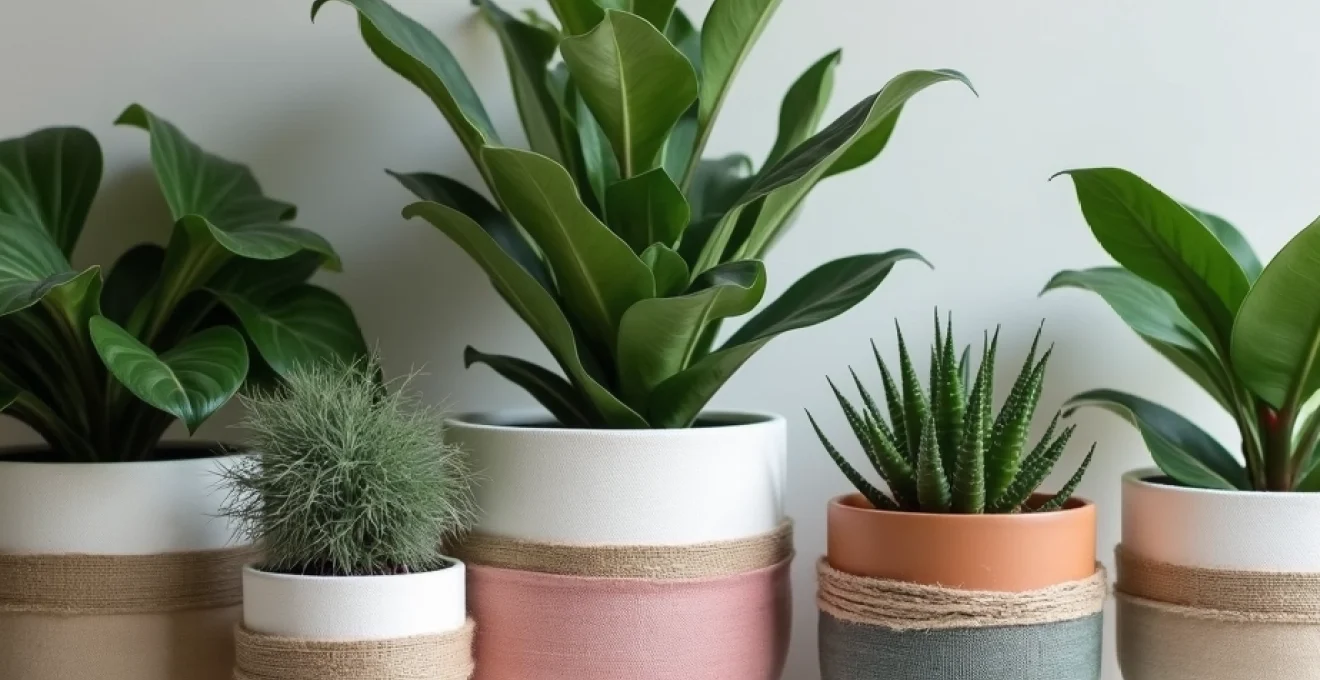
Transform your indoor garden with sophisticated fabric-wrapped planters that elevate ordinary containers into stunning botanical statements. This comprehensive approach to planter customisation combines traditional crafting techniques with modern design principles, creating unique displays that complement contemporary interior aesthetics. Professional-quality results depend on selecting appropriate materials, mastering precise application methods, and understanding how different fabric properties interact with various container surfaces.
The growing trend towards personalised home décor has sparked renewed interest in DIY planter projects, particularly those featuring natural textile applications. Fabric-wrapped planters offer unlimited creative possibilities whilst providing practical benefits including enhanced insulation for root systems and improved moisture retention. These versatile accessories suit various botanical arrangements, from dramatic statement plants to delicate herb collections.
Essential materials and tools for professional Fabric-Wrapped planter construction
Achieving professional-grade fabric-wrapped planters requires careful selection of materials and specialised tools designed for textile applications. The foundation of any successful project begins with understanding how different components interact to create durable, aesthetically pleasing results. Quality materials ensure longevity whilst appropriate tools facilitate precision application and professional finishing.
Natural fibre selections: linen, cotton canvas, and hessian properties
Natural fibres provide superior adhesion properties and enhanced breathability compared to synthetic alternatives. Linen fabrics offer exceptional durability and develop an attractive patina over time, making them ideal for long-term botanical displays. The natural texture of linen complements organic plant forms whilst providing sufficient structural integrity to maintain shape around container curves. Linen’s natural antimicrobial properties resist mould development in humid environments typically associated with plant care.
Cotton canvas represents the most versatile option for fabric-wrapped planters, delivering reliable performance across various container shapes and sizes. Heavy-weight cotton canvas provides excellent coverage whilst maintaining flexibility during application. Pre-shrunk cotton varieties eliminate dimensional instability concerns that could compromise finished appearance. The tight weave structure of quality cotton canvas ensures consistent adhesive penetration whilst preventing fraying during handling.
Hessian fabrics contribute rustic charm whilst offering practical advantages for specific applications. The loose weave structure allows enhanced drainage around container bases, reducing moisture accumulation risks. Natural jute fibres provide inherent water resistance whilst maintaining breathability essential for healthy root environments. Hessian works particularly well with terracotta containers, creating harmonious natural material combinations.
Adhesive systems: E6000 vs PVA vs hot melt application techniques
Professional adhesive selection directly impacts both immediate application success and long-term durability. E6000 industrial-strength adhesive provides permanent bonding suitable for outdoor applications and high-moisture environments. The flexible cured formula accommodates thermal expansion whilst maintaining secure fabric attachment. Application requires adequate ventilation and extended curing times, typically 24-48 hours for full strength development.
PVA-based adhesives offer user-friendly application with reliable bonding strength for indoor applications. Water-based formulations provide easier cleanup whilst maintaining sufficient holding power for lightweight fabric applications. Modified PVA systems incorporate plasticisers that enhance flexibility and moisture resistance beyond standard formulations. These adhesives work exceptionally well with natural fibres, creating strong mechanical bonds through fibre penetration.
Hot melt adhesive systems enable rapid application with immediate bonding capability. Temperature-controlled application guns ensure consistent adhesive flow whilst preventing fabric scorching. The thermoplastic properties allow repositioning during initial application phases whilst providing permanent bonding once cooled. Hot melt systems prove particularly effective for high-volume projects requiring consistent application speed.
Planter base materials: terracotta, ceramic, and plastic container compatibility
Container material properties significantly influence adhesive selection and application techniques. Terracotta’s porous surface structure provides excellent mechanical bonding opportunities for most adhesive systems. The natural clay composition allows slight moisture absorption that can enhance certain adhesive cure processes. Surface preparation typically requires only basic cleaning to remove manufacturing residues or previous coatings.
Ceramic containers present smooth, non-porous surfaces requiring specific adhesive formulations designed for low-energy substrates. Surface preparation becomes critical for ceramic applications, often requiring light abrasion to improve mechanical bonding. Glazed ceramic surfaces may require specialised primers to achieve optimal adhesion strength. The thermal stability of ceramic containers allows use of heat-activated adhesive systems without substrate damage concerns.
Plastic containers offer lightweight alternatives with varying surface energy characteristics depending on polymer composition. Polyethylene and polypropylene surfaces require flame treatment or chemical primers to achieve reliable adhesion. Higher-energy plastics like PET provide better natural adhesion properties. Flexible plastic containers may require adhesive systems that accommodate substrate movement without bond failure.
Specialised tools: fabric scissors, seam rippers, and heat guns
Professional-quality tools ensure precise fabric cutting and clean application results. Sharp fabric scissors designed for heavy materials provide clean cuts that prevent fraying during handling. Ergonomic designs reduce hand fatigue during extended cutting sessions whilst maintaining cutting precision. Regular blade maintenance ensures consistent performance throughout project duration.
Seam rippers serve multiple functions beyond traditional sewing applications, including precise adhesive removal and fabric adjustment during installation. The sharp point allows detailed work around container curves whilst the protective ball prevents accidental fabric damage. Quality seam rippers feature comfortable handles and replaceable cutting elements for extended service life.
Variable-temperature heat guns provide controlled warming for improved adhesive flow and enhanced fabric conformability around complex container shapes. Temperature control prevents fabric damage whilst accelerating cure processes for appropriate adhesive systems. Concentrated airflow allows precise heat application without affecting surrounding areas.
Advanced fabric preparation techniques for optimal adhesion
Proper fabric preparation forms the foundation of professional fabric-wrapped planter construction. Advanced preparation techniques eliminate common failure modes whilst enhancing both appearance and durability. Understanding fabric behaviour under various conditions allows selection of appropriate preparation methods that optimise final results.
Pre-washing and shrinkage control methods
Pre-washing removes manufacturing residues and sizing compounds that can interfere with adhesive bonding. Hot water washing followed by high-temperature drying induces maximum dimensional changes before application, preventing post-installation distortion. Natural fibres typically experience 3-5% shrinkage during initial washing cycles, with stabilisation occurring after 2-3 wash cycles.
Controlled shrinkage processes ensure dimensional stability throughout the service life of fabric-wrapped planters. Steam treatment provides alternative shrinkage control for delicate fabrics that might suffer damage during conventional washing. Progressive temperature increases during drying cycles maximise shrinkage whilst preventing heat damage to sensitive fibres.
Fabric stabilisation treatments using diluted fabric softener solutions can improve handling characteristics whilst maintaining adhesive compatibility. These treatments reduce static electricity generation during cutting and application phases. Proper stabilisation enhances fabric draping properties around curved container surfaces.
Edge finishing: french seams and overlocking for durability
Professional edge finishing prevents fraying whilst creating clean, finished appearances. French seam construction encases raw edges within folded fabric layers, providing superior durability compared to simple hem treatments. This technique works particularly well with lightweight fabrics that might otherwise show raw edges through the finished surface.
Overlocking techniques using serger machines create professional-grade edge finishes whilst trimming excess material simultaneously. Four-thread overlock configurations provide maximum durability for heavy-use applications. The interlocked thread structure distributes stress loads whilst maintaining flexibility around container curves.
Heat-sealed edges offer alternative finishing methods for synthetic fabrics. Controlled heat application melts fibre ends together, creating permanent edge seals that resist fraying under all conditions. This technique requires precise temperature control to prevent fabric damage whilst achieving complete edge sealing.
Pattern matching and grain line alignment strategies
Proper pattern matching creates seamless appearances around cylindrical containers whilst maintaining design continuity. Careful measurement and marking ensure pattern elements align correctly after wrapping around container circumferences. Pattern repeat calculations determine fabric requirements whilst minimising waste during cutting operations.
Grain line alignment affects both appearance and performance characteristics of finished installations. Proper grain orientation ensures consistent stretch properties whilst preventing unwanted distortion during application. Cross-grain applications may provide enhanced conformability around complex curves but can compromise long-term dimensional stability.
Advanced marking techniques using temporary chalk or disappearing ink facilitate precise pattern placement without permanent marks on finished surfaces. Registration marks allow accurate alignment during application phases. Computer-aided design tools can assist in complex pattern matching calculations for elaborate designs.
Interfacing applications for structured planter wrapping
Fusible interfacing provides additional body and structure for lightweight fabrics whilst improving adhesive bonding characteristics. Iron-on applications create permanent bonds that enhance fabric stability during handling and installation. Weight-appropriate interfacing selection maintains fabric draping characteristics whilst providing necessary structure.
Woven interfacings offer superior dimensional stability compared to non-woven alternatives. The stable construction prevents bias stretch that could compromise pattern alignment during installation. High-quality woven interfacings maintain their properties through multiple moisture exposure cycles.
Specialised interfacings designed for outdoor applications provide enhanced moisture resistance whilst maintaining breathability essential for plant health. These materials incorporate water-repellent treatments that prevent moisture-related adhesive failure. UV-resistant formulations maintain structural integrity under prolonged sunlight exposure.
Step-by-step wrapping methodologies for different container shapes
Successful fabric wrapping requires adapted techniques for various container geometries. Each shape presents unique challenges regarding fabric conformity, adhesive application, and finishing details. Professional results depend on understanding how fabric behaviour changes across different surface configurations and adjusting methods accordingly.
Cylindrical planter wrapping: seamless join techniques
Cylindrical containers represent the most straightforward wrapping applications but require precision for professional seamless joins. Begin by measuring container circumference and adding 2-3cm overlap allowance for secure bonding. Height measurements should include top and bottom wrap-around allowances of 3-4cm each. Accurate measurements prevent material waste whilst ensuring complete coverage.
The overlapped seam technique provides the strongest joint configuration for cylindrical applications. Position the overlap along the container’s least visible side, typically the back when displayed. Apply adhesive to both fabric layers within the overlap zone, ensuring complete coverage for maximum bonding strength. Press firmly and maintain pressure during initial cure phase.
Spiral wrapping methods eliminate visible seams entirely by creating continuous fabric coverage around the container circumference. This technique requires careful planning to ensure even coverage whilst maintaining consistent fabric tension. Begin at the container base and work upward in overlapping spirals, maintaining 1-2cm overlap between successive wraps.
Professional fabric wrapping success depends on maintaining consistent tension throughout the application process whilst avoiding over-stretching that could compromise the fabric’s structural integrity.
Square and rectangular container applications
Angular containers require modified techniques to accommodate corner transitions without creating fabric bunching or gaps. The envelope method involves creating precise corner pleats that distribute excess fabric evenly whilst maintaining clean edge lines. Mark corner fold lines before adhesive application to ensure accurate placement during installation.
Corner mitering techniques eliminate bulk accumulation at container corners whilst creating professional finished appearances. Calculate miter angles based on container proportions, typically 45-degree cuts for square containers. Test-fit all corners before final adhesive application to ensure proper alignment.
Box-pleat configurations accommodate the volume requirements of rectangular containers whilst maintaining fabric grain alignment along major surfaces. This technique requires additional fabric but produces superior finished appearance with consistent surface tension across all faces.
Tapered pot configurations and fabric gathering methods
Tapered containers present unique challenges requiring controlled fabric gathering to accommodate changing circumferences. Dart construction techniques remove excess fabric systematically whilst maintaining smooth surface appearance. Calculate dart placement to distribute gathering evenly around the container circumference.
Progressive gathering methods use elastic threads or drawstring configurations to create controlled fabric compression around tapered sections. This approach maintains fabric flexibility whilst ensuring secure attachment. Adjustable gathering systems accommodate thermal expansion without compromising bond integrity.
Heat-forming techniques using steam or controlled heat application can pre-shape fabric to match container contours. This method works particularly well with natural fibres that respond favourably to moisture and heat treatment. Allow complete cooling and moisture evaporation before adhesive application.
Drainage hole management and waterproofing solutions
Proper drainage hole management prevents moisture accumulation whilst maintaining structural integrity around critical areas. Create precise hole alignments by marking container positions before fabric installation. Use sharp craft knives to create clean cuts that prevent fraying around drainage areas.
Waterproofing treatments around drainage zones protect fabric integrity whilst allowing necessary water flow. Silicone-based sealants provide flexible waterproof barriers that accommodate fabric movement. Apply treatments after initial adhesive cure to prevent interference with primary bonding.
Reinforcement techniques using additional fabric layers or interfacing around high-stress areas improve long-term durability. Strategic reinforcement placement addresses potential failure points without compromising overall appearance. Consider using contrasting colours to create decorative accents around reinforced areas.
Botanical styling integration with monstera deliciosa and fiddle leaf figs
Large-format plants require carefully considered container sizing and fabric selection to create harmonious displays that enhance rather than compete with natural plant forms. Monstera deliciosa specimens benefit from neutral-toned fabrics that complement their distinctive fenestrated foliage without overwhelming the visual composition. The substantial root systems of mature monsteras require containers with adequate capacity, typically 40-50cm diameter for established specimens.
Fiddle leaf figs present unique styling challenges due to their dramatic vertical growth patterns and distinctive broad leaves. Container proportions become critical factors in maintaining plant stability whilst creating visually balanced compositions. Heavy ceramic containers wrapped in structured fabrics provide necessary weight distribution for tall specimens whilst contributing to overall aesthetic coherence.
Fabric pattern selection should consider plant growth characteristics and seasonal changes in foliage density. Bold geometric patterns work well with architectural plants like snake plants or ZZ plants, whilst organic textures complement the natural forms of ferns and trailing varieties. Consider how fabric choices will interact with changing light conditions throughout the day as plants cast shadows on container surfaces.
Colour coordination between fabric selections and existing interior design elements creates cohesive botanical displays that integrate seamlessly with established décor schemes. Earth tones and natural fibres enhance biophilic design principles whilst maintaining flexibility for seasonal plant rotations. Neutral palette foundations allow accent colour introduction through smaller accessories without overwhelming primary plant displays.
Long-term maintenance protocols for Fabric-Wrapped garden displays
Establishing comprehensive maintenance protocols ensures fabric-wrapped planters maintain their aesthetic appeal and structural integrity over extended service periods. Regular inspection schedules identify potential issues before they compromise overall display quality. Document maintenance activities to track performance patterns and identify optimal service intervals for different fabric and adhesive combinations.
Cleaning procedures should accommodate both fabric properties and plant care requirements without introducing chemicals that might harm root systems. Vacuum cleaning with soft brush attachments removes surface dust whilst avoiding moisture introduction that could compromise adhesive bonds. Spot cleaning techniques address localised staining without saturating surrounding fabric areas.
Moisture management becomes critical for maintaining adhesive integrity whilst supporting healthy plant growth. Monitor humidity levels around fabric-wrapped containers, particularly in bathroom or kitchen locations where elevated moisture levels are common. Install humidity monitoring devices to track conditions and adjust watering schedules accordingly.
Seasonal maintenance protocols address changing environmental conditions that affect both plants and container materials. Spring inspections focus on winter damage assessment and preparation for increased growing season demands. Autumn protocols prepare displays for reduced light conditions and modified watering requirements during dormancy periods.
Proactive maintenance approaches prevent minor issues from developing into major problems that could require complete container rewrapping or plant transplantation.
UV protection treatments extend fabric life in locations receiving direct sunlight exposure. Spray-on UV inhibitors designed for textile applications provide transparent protection without altering fabric appearance. Reapplication schedules depend on exposure intensity and fabric composition, typically requiring renewal every 6-12 months for maximum effectiveness.
Troubleshooting common fabric wrapping failures and repair solutions
Identifying failure modes early enables targeted repair interventions that restore functionality without complete reinstallation. Edge lifting typically results from inadequate surface preparation or incompatible adhesive selection. Address lifting areas immediately by cleaning exposed surfaces and applying fresh adhesive with extended clamping time for complete bonding.
Fabric fraying around high-wear areas requires prompt attention to prevent progressive deterioration. Emergency repairs using clear nail polish or fabric glue can stabilise fraying until permanent solutions are implemented. Permanent repair techniques
involve applying patch materials that match original fabric characteristics. Cut replacement pieces slightly larger than damaged areas and apply using identical adhesive systems to maintain consistent bonding properties.
Adhesive failure manifests as complete bond loss between fabric and container surfaces. This typically results from moisture infiltration, temperature cycling, or incompatible material combinations. Complete adhesive removal requires solvent cleaning to eliminate residual contamination before reapplication. Surface preparation becomes critical for successful repairs, often requiring light abrasion to restore bonding characteristics.
Colour fading in direct sunlight locations requires proactive protection measures. Relocate affected containers to filtered light positions during peak UV exposure periods. Fabric replacement may become necessary for severely faded installations, providing opportunities to implement improved UV protection protocols for enhanced longevity.
Container thermal expansion can stress fabric installations beyond adhesive capacity, particularly with metal containers in temperature-variable environments. Monitor temperature differentials and consider flexible adhesive systems for applications subject to significant thermal cycling. Emergency stabilisation using temporary mechanical fasteners can prevent complete failure while permanent solutions are implemented.
Mould development on natural fibres requires immediate attention to prevent health concerns and structural damage. Remove affected plants temporarily and treat fabric surfaces with diluted vinegar solutions that eliminate fungal growth without damaging fibres. Improved ventilation protocols prevent recurrence by maintaining appropriate moisture levels around container installations.
Professional repair techniques restore functionality whilst maintaining aesthetic consistency with original installations. Document repair procedures and materials used to establish maintenance protocols for similar future issues. Consider upgrading to improved materials during repair processes to enhance overall system performance and longevity.
Systematic troubleshooting approaches identify root causes rather than addressing symptoms alone, ensuring repairs provide lasting solutions rather than temporary fixes.
Quality control measures during initial installation prevent many common failure modes. Establish inspection checklists that verify proper surface preparation, adequate adhesive coverage, and appropriate curing conditions before considering installations complete. Regular training updates ensure installation personnel maintain current knowledge of best practices and emerging techniques.
Advanced repair materials including structural adhesives and reinforcement fabrics provide enhanced durability compared to original installation materials. Consider repair opportunities as system upgrades rather than simple restoration projects. Investment in superior materials during repair phases often proves cost-effective compared to frequent maintenance requirements.
Documentation systems tracking failure patterns and repair effectiveness guide future installation decisions and maintenance scheduling. Photographic records of failure modes assist in training personnel and developing improved installation procedures. Performance data analysis identifies optimal material combinations and application techniques for specific environmental conditions.